Friday, January 4, 2008

Resident Evil and Resident Evil: Apocalypse


I recently re-watched these two movies. The movies are not all that good. For some reason I like them though. I really don't know why. The story is not original, the character inter action is not that good, and some parts do not make sense. The games are much better than the movies.

I don't really know why I like zombie films to being with. No one else I know likes them. Most are poorly written or formulaic. Sure some are good like Frankenstein and Dawn of the Dead but most are not good. Even before I watch them I know that the movies are going to be bad but I watch them anyways. Something about zombies fascinate me.

Basic summary of the first movie: A mega-corporation is creating genetically engineered virus's and monsters. A vile containing a deadly virus is broken and is spread through out the entire complex via the ventilation system (which is pretty stupid if you think about it, since you'd think that a room that is being used to create or study virus would be self contained and not connected to the entire complex via air ducts). The super computer that controls the complex notices that the virus is released. Seals complex and kills everyone so the virus does not spread. A task force infiltrates the complex to find out why that happened (you'd think they would have been able to interface with the Artificial intelligence via remote but guess not). They shut down the computer (which for some reason did not explain why it did what it did), releasing the zombies. Then basic zombie movie.

Basic summary of second movie: Continuation of first movie. The mega-corporation let zombies out infecting most of the city. Standard zombie film with characters trying to leave the city. More detailed summary's can be found elsewhere.

A few questions that occurred to me while watching:

Why don't the zombies eat other zombies? They are brought back to life via the T-virus with basic motor skills, over powering need to feed, and virtually no intelligence. They are hungry and other zombies are around why don't they eat one another as well as the living? Are they given some instinct that makes them only want to eat the living and the truly dead? Zombies are stupid why don't we ever seem to see them attempt to eat inedible items like sticks or something?

In Resident Evil: Apocalypse there is a scene with them walking through a cemetery and zombies come out of the graves. How is this possible? In the first film they explained that the T-virus brings recently dead cells to life and requires the brain to still have some electrical energy (also used the incorrect myth of hair and nails still growing after you die to explain how its possible). Those beings in the graves have been dead too long for them to be reanimated. Also how did they get infected? The virus is passed on through bodily fluids (started air born but had already passed that stage else everyone would have already been infected) and they are buried under ground well away from any means of passing the virus to them.

How did Nemesis know that 13 were star agents and 1 wasn't? I can understand distinguishing an armed civilian and a non-combatant, but how did it know that the others were STAR personnel. The only way I could conceive this happening is took a good look at there faces or saw there uniforms and compared it to data stored in memory. It couldn't have done that though since it did not get a good look at all of them and later it knew Jill Valentine was a STAR member even though she did not have a uniform on.

I can easily accept some things like a virus that reanimates the dead, a giant corporation getting away with basically anything, a genetically engineered virus that mutates living things, Hollywood science like the bike exploding from a bullet shot through the gas tank, and other things but some things are just to unrealistic or go against established abilities for me to accept like the the above graveyard zombies and the Nemesis monster being able to distinguish the people.

Things I did like about the movies is people messing with things they shouldn't (i.e. Virus's), giant corporation that gets away with basically anything (there are several real life organizations which get away with a lot more than they should and that are more powerful than some countries), and mindless violence (I maybe a non-violent person and promote peace but occasionally I like to watch or play fake violence).

Movies can be purchased here: Amazon store

Sheep Rare

Sheep are very rare in Japan and most Japanese people do not know what they look like. The story below taken from Ananova clearly shows this.

Ewe've been had

Thousands of rich Japanese women were conned into believing lambs were valuable miniature poodles.

Flocks were imported from the UK and Australia to be sold by an internet company as the latest "must have" pet.

The scam was rumbled when movie star Maiko Kawakami complained on a talk show that her new poodle refused to bark or eat dog food.

She showed photos of the animal and was devastated when told that it was a lamb, reports the Sun.

Hundreds of women contacted police to say that they had also been sold lambs instead of pedigree pups by the con artists based in Sapporo.

One couple found out the truth only after a dog beautician told them she could not trim their poodle's claws - because they were hooves.

The company, whose name translated as Poodles As Pets, has now been shut down.

Bosses took advantage of the fact sheep are rare in Japan and most people do not know what they look like.

They advertised poodles online for £630 - half the price of the highly-desired puppies in Japan at £1,260.

A police spokesman said: "We launched an investigation after we were made aware that a company were selling sheep as poodles."

Ranma Professional Thief

While Ranma does not care very much for material things he has stolen things from others a few times. Steals the dragon whisker soup from the guy who stole it, stole mushroom from Ryoga, stole food from hot spring island owner, etc., and he has made several attempts to steal things for various reasons during the manga for example the magic sword from Kuno, the instant boy water from Shampoo, magic soap from Ryoga, etc.

If Ranma decided to become a professional thief instead of an amateur occasional one what type do you think he would be most often? I realize he would most likely use all the types since he did use all the types in some form in the manga but which style do you think he would prefer if he became a pro thief or was challenged by one?

1. Showy like Lupin (Lupin 3rd) or Kaito kid (Kaito kid/Detective Conan). Ranma is very confident in his abilities and is not adverse to showing off. He could use techniques like the ones in his battle with Mousse in which he blew himself up, his body switching technique (switched with a bear at Miss Hinako's, a log in battle with Herb, a statue to get away from Ryoga, etc.), ventriloquism (one time he faked Akane's voice to mess with Ryoga and another time he faked Ryoga's voice to mess with Akane and Ryoga) and disguises (Ranma uses disguises several times).

2. Seductive like Fujiko - using tactics like dating/seducing/feminine charms to get stuff like how he pretended to be a Jr Highschool girl with a crush on Ryoga to see the Shishihadoken scroll or how he tried to be seductive to get the instant Jusenkyo water from Shampoo and drugging the person (paralysis powder on Shampoo, drugged Kuno's food).

3. Unseen Ninja Like - Using techniques from the umisenken, wall crawling, and other ninja techniques to steal without being seen.

4. Brute force - Straight out stealing the stuff using brute force techniques like the Yamasenken techniques, ki blasts, etc. Over powering or breaking anything in his way and out running any pursuit.

The poll had been up for more than a year now and here are the results:
-45 people voted (or at least 45 were recorded, the poll was not functioning correctly)
- 31% said showy
- 11% said seductive
- 42% said unseen
- 16% said brute force

If you want to, you can leave a comment with your choice, I will read them.

Wednesday, January 2, 2008

Abitibi Paper Recycling


In the area I live at there are these Green and Yellow dumpsters called Abitibi paper retriever. I like the idea. You drop in your junk mail, newspapers, magazines, miscellaneous paper and they recycle it with a portion of the profits going to the charity (i.e. place with the bin). Where I live they do not collect loose paper only bundled Newspaper in the regular recycling truck. I put a box in my basement and throw all my junk paper in there. Once the box fills up I dump the paper at one of the boxes. I drop them in three separate boxes, depending on where I happen to be going (I do not like making multiple trips). A fire station, a church, and a school. I really like the idea. I'm getting rid of paper that I'd otherwise throw away and helping a good cause at the same time.

According to the company, one ton of recycling paper saves 3 cubic yards of landfill space, 4,102 kilowatts of electricity, 60 pounds of air pollution and 70 gallons of water. They have boxes across the US, Canada, and the UK. There website where you can get more information is (such as locations) here: http://paperretriever.com/ by dropping your loose paper and newspapers into these boxes your both recycling the paper and helping local charities. If your neighborhood doesn't have a paper recycling box at the schools/churches/fire stations ask them to sign up with it as a way to better the earth and earn some money on the paper they would otherwise throw out.

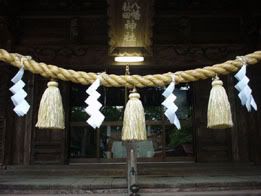
Shimenawa


A Shimenawa is a sacred straw rope used in Shintoism to indicated something is sacred and to ward evil. The rope is made from greenish rice straw with pieces of white paper hanging. On New Years day a special Shimenawa called shimenawa-kazari is hung above an entrance to a home to symbolize purification and welcome the new years gods. The New Years one has other things hung from it besides white paper. They hang oranges, lobsters, fern leaves, etc. the decorations depending on what they hang mean prosperity, good fortune, longevity, etc.

Tuesday, January 1, 2008

Shogatsu - New Year

Shogatsu, New Years' Day is the most important holiday of the year in Japan. For New Years the majority of businesses shut down from January first to January third so that people can celebrate the holiday. Prior to 1873 (the year the Japanese adopted the Gregorian calendar), Shogatsu was celebrated at the beginning of spring.

Hatsuhinode - At dawn in Japan, many people go to the coast or a high place to watch the sun rise. Television stations also broadcast the sun rising over different locales in the country starting with the earliest. The view of the rising sun is thought to bring good luck for the new year. New Year Day is a day of peace and rest.

Bonenkai (Forget-the-year Parties) are held throughout December while Shinnenkai (New Year Parties) are held throughout January. They are social gatherings of company workers, business and other friends and usually take place in restaurants and involve massive amounts of drinking. The bonenkai is a party to forget the unpleasant memories of the passing year. Shinnenkai are parties to welcome the New Year with a fresh and serene mind. At the party, bosses usually tell their staff to be Breiko (to forget their position and be impolite), because the relationship in the workplace in Japan is a bit strict. Bonenkai are more popular than Shinnenkai and company workers tend to go to more of them than students do.

Foods for New Years - It is common to prepare food for New Years on New Year's eve (originally this had to do with making the kami of the kitchen happy, no refrigeration and stores being closed, nowadays just tradition). The foods eaten on New Years are usually served cold, the main meal of the day is called osechi-ryōri. A popular food eaten on New Years is mochi (boiled sticky rice mashed into a dumpling) -because it is extremely sticky some people end up chocking to death on it, check the day after newspaper for a list.

Otoshidama - During New Years it is customary for parents and other relatives to give children money in small decorated envelopes called pochibukuro; this practice is called Otoshidama. In the Edo period large stores and wealthy families gave out a small bag of mochi and a Mandarin orange to spread happiness all around. The amount of money given depends on the age of the child but is usually the same if there is more than one child so that no one feels slighted; for Jr and Sr Highschool students the amount given is generally 5,000 to 10,000 yen per gift. For this reason, the time just after New Years is the busiest season for toy/electronic shops.

A list of firsts:
shigoto-hajime - the first day of work of the new year
keiko-hajime - first practice of the new year
hatsugama - first tea ceremony of the new year
hatsu-uri - first shopping sale of the new year
hatsudayori - first exchange of letters
kakizome - first calligraphy
fude hajime - first brush
waraizome - first laughter (starting the year with a smile is good)
hatsuyume - first dream (dreaming about, or some combination of, hawks, eggplants, and Mount Fuji are said to bring good luck for the rest of the year).

Hatsumode - is the first shrine (or temple, or church) visit of the New Year in Japan. Many people do this just after midnight so as to hear the bells ringing and do this at the same time. Even though many people do it just after midnight the shrines all over Japan are packed with people from the New year’s day to January third. People go to shrine to pray for the things most people pray for; safety, health, luck, happiness, peace, and long lives of the family. A lot of people are dressed up with their Kimono. People buy good luck talismans called Omamori and returns the old ones so they can be burned. They also get omikuji, which are random fortunes written on strips of paper at Shinto shrines and Buddhist temples in Japan. It is thought that the custom of Hatsumode comes from Toshigomori. Toshigomori was originally as a form of monoimi (a ritual period of abstinence) to cleanse one self for the New Year. Toshigomori was practiced by secluding oneself in a shrine from the early evening of New Year's Eve onward and to stay awake all night before the deity. The shrine that you go to should be in an auspicious direction, the direction where this year's Toshitokujin lived and no cursed god (tatarigami) was to come. This is determined by the zodiac sign.

It is customary to play many New Year's games. With the increase of electronic games (i.e. Video Games) this tradition is declining. Some traditional games are hanetsuki, takoage (kite flying), koma (top), sugoroku (a board game), fukuwarai (a game in which a blindfolded person places paper parts of a face, such as eyes, eyebrows, a nose and a mouth, on a paper face), karuta (card game), and others.

"Happy New Year" in Japanese - あけましておめでとうございます said Akemashite omedeto gozaimasu.

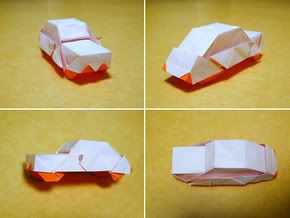
Paper Drivers


In Japan most people get driver's licenses when they become 18 years old (the legal driving age). If a person says they are a paper driver (pêpâ doraibâ) that means that they have a driver's license but never drive. Generally because they don't own a car. In Japan the subway system is very extensive and can get you just about anywhere so cars are not needed as much.

In Japan, cars are driven on the left side of the road and have the driver's seat and steering wheel on their right side. Road signs and rules follow international standards, and most signs on major roads are in Japanese and English. Drinking and driving is strictly prohibited.

The typical speed limits are 80 to 100 km/h on expressways, 40 km/h in urban areas, 30 km/h in side streets and 50 to 60 km/h elsewhere. Drivers usually exceed the speed limits by about 10 km/h.

If you want to drive a car while in Japan and don't have a Japanese drivers license, you must obtain an International Driving Permit prior to your departure (hey cannot be obtained in Japan). International Driving Permits are generally issued by the national automobile association in your country. Not every countries driving permits are acceptable in Japan and a Japanese driver's license is required for all drivers who stay in Japan for more than one year. Only if you leave Japan for more than three consecutive months are you again allowed to use an international driving permit.

A good site with more info on driving on Japan is: Ajet - Driving in Japan